10 Best SEO Tools for Beginners in 2026
Compare the best SEO tools for beginners, including free and freemium picks for keywords, audits, rankings, backlinks, content, and site speed.
Written by Devnitys Team
You've published a site, written a few pages, and now you're staring at a long list of possible SEO tasks. Should you research keywords first, check whether Google has indexed the pages, improve speed, fix technical errors, or start studying competitors and backlinks? The right answer depends on the task, your budget, your site platform, and how much technical detail you're willing to learn.
The best SEO tools for beginners aren't necessarily one oversized platform. A lean setup usually combines first-party Google data, a WordPress publishing guide when needed, a focused crawler for technical checks, and an optional paid suite when competitive research or reporting justifies it. This list organizes ten tools by the beginner problem each one solves, then shows how to combine them without paying for features you won't use.
SEO tooling has developed from simple keyword and link utilities into broader platforms. One history places the first SEO software product, WebPosition Gold, in 1995, while later milestones include Google Webmaster Tools, now Google Search Console, MozBar, SEMrush, Ahrefs, and Ubersuggest, as documented in this history of SEO tools. Devnitys can also help you discover and compare free online tools, but each resource below should be judged by the workflow it supports, not by how many features appear on its homepage.
1. Google Search Console
Google Search Console should be the first tool connected to almost every website. It's free, uses data from Google Search, and answers the questions beginners need answered first: which queries produce visibility, which pages receive clicks, and whether Google can access and index important URLs. Set it up before buying a broad SEO suite.
The Performance report shows clicks, impressions, click-through rate, and average position. These metrics work best together. Impressions without clicks may point to a weak search snippet or mismatched intent. A page with impressions and some visibility but limited clicks may need a clearer title, stronger description, or better alignment with the query.
What to use first
URL Inspection helps you check an individual page and request indexing when appropriate. The Page indexing report gives you a wider view of excluded or problematic URLs, while Sitemaps lets you submit the XML sitemap your site generates. Search Console also surfaces security problems and manual action notifications, so it's more than a ranking dashboard.
- Performance reports: Find queries and pages that already have search visibility.
- URL Inspection: Check Google's view of a specific page.
- Sitemaps: Help Google discover your site's intended URL set.
- Security and manual actions: Watch for serious issues that can affect visibility.
Practical rule: Don't treat average position as a promise of a fixed ranking. Use it to identify pages and queries that deserve investigation.
Search Console's data is aggregated and anonymized, and it doesn't provide the same competitor or backlink depth as paid suites. That limitation is acceptable at the beginning. The direct indexing and performance diagnostics are more actionable than a crowded dashboard full of estimated data. Start with the official Google Search Console, verify your site, and review the Performance and Page indexing reports regularly.
2. Google Keyword Planner
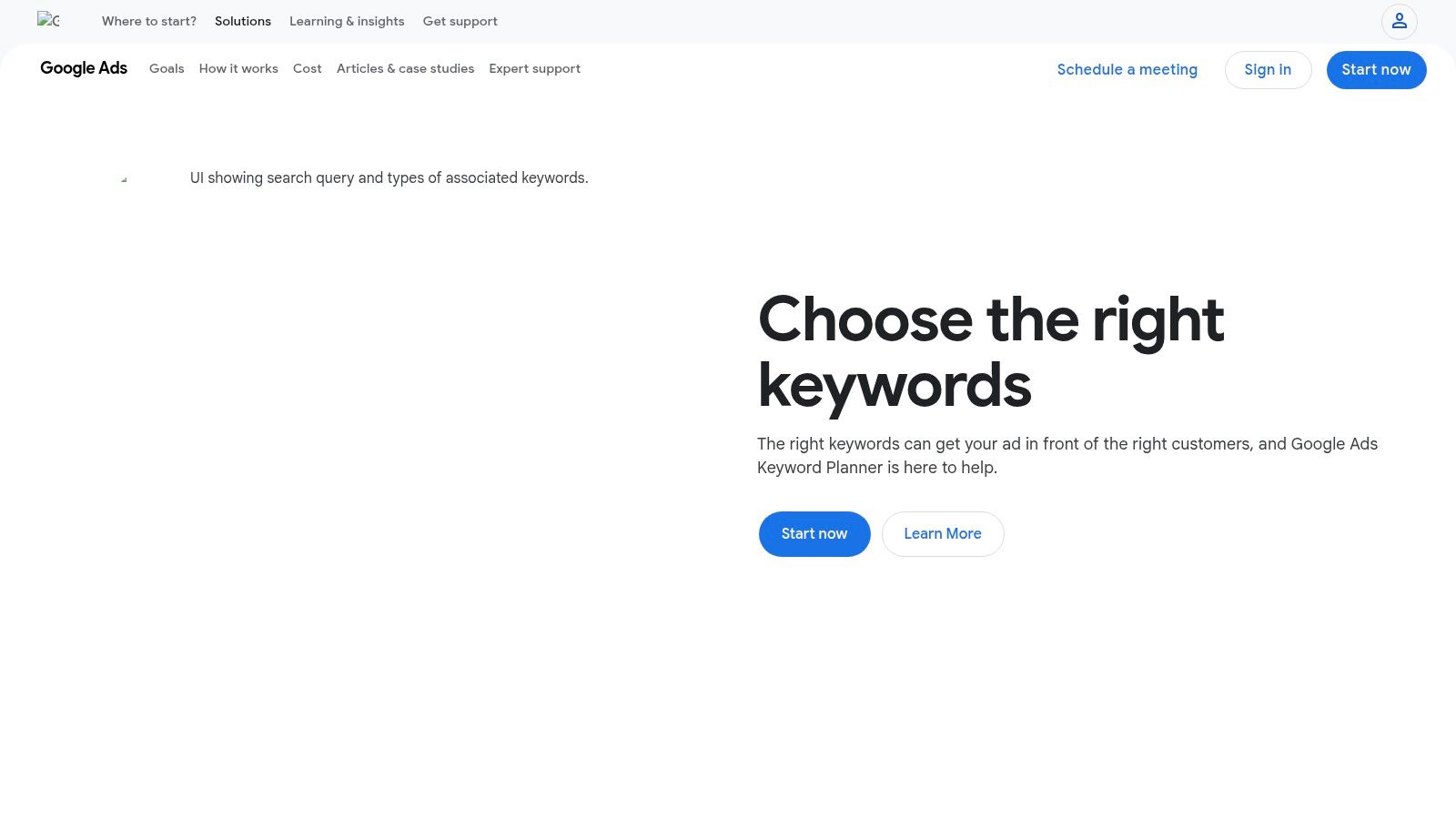
Keyword Planner is a useful starting point when you need topic ideas but don't yet need a full keyword platform. It lives inside Google Ads and can generate suggestions from a seed phrase or website, with estimates and forecasts that help you compare possible topics. The interface is designed for advertisers, so SEO beginners need to interpret the output rather than copy it blindly.
Use Discover new keywords to enter a broad topic, a specific phrase, or a relevant website. Filters can narrow ideas by location, language, and network. Forecasts include bid and traffic estimates, which are useful context for commercial intent, but they don't turn an estimate into a guaranteed organic opportunity.
Turn suggestions into a content plan
A beginner-friendly workflow is to export or record relevant ideas, group close variants by intent, and then decide which topics deserve separate pages. Don't create a page for every minor wording variation. A single useful article can often address several closely related searches when the underlying need is the same.
- Start with a seed topic: Use the language your customers use, not only industry terminology.
- Inspect related ideas: Look for questions, comparisons, and problem-focused searches.
- Filter deliberately: Location and language settings matter when your audience is specific.
- Validate with your site data: Later, compare these ideas with queries appearing in Search Console.
Keyword Planner requires a Google Ads account, and its figures are estimates rather than exact counts. That makes it better for discovering and comparing demand than for making precise traffic promises. For a broader set of beginner options, consult these free SEO keyword research tools, then return to the Google Keyword Planner when you need Google's own keyword environment.
3. Yoast SEO for WordPress
WordPress users often need publishing guardrails more than another research dashboard. Yoast SEO places practical SEO and readability guidance inside the editor, helping you review titles, descriptions, focus phrases, internal content signals, and social previews before publication. It also handles important technical foundations, including XML sitemaps and structured data features.
The traffic-light analysis can be helpful when you're learning what an optimized page should contain. It can flag missing or poorly placed elements, but it shouldn't dictate the article's voice or force unnatural keyword repetition. A page that satisfies a plugin's checklist can still fail if it doesn't answer the searcher's question clearly.
Keep the plugin stack clean
Yoast can automatically support canonical settings, index controls, social metadata, and schema output. Those features reduce the need for manual configuration, particularly for a new WordPress site. The risk comes from installing several plugins that attempt to manage the same metadata, redirects, schema, or sitemap functions.
- Use the editor guidance: Treat it as a pre-publication review, not a ranking score.
- Preview social sharing: Check how titles and images may appear when pages are shared.
- Review index controls: Keep low-value administrative or duplicate pages out of search when appropriate.
- Avoid overlap: Choose one primary SEO plugin rather than stacking competing systems.
Advanced workflows, such as redirects and expanded internal-linking support, may require Premium. The free version is often enough for a small publishing site that needs dependable basics. You can find Yoast SEO on WordPress.org and use it alongside Search Console, rather than expecting the plugin to replace Google's own performance data.
4. PageSpeed Insights for Core Web Vitals
PageSpeed Insights helps you separate a vague complaint, “the site feels slow,” from specific performance work. Enter a URL and the tool combines laboratory diagnostics with available real-user field data. It evaluates Core Web Vitals such as LCP, CLS, and INP, then presents recommendations for mobile and desktop experiences.
The most useful beginner habit is to focus on the highest-priority opportunities instead of chasing a perfect score. A score can fluctuate with device, network, page state, and test conditions. The practical objective is to improve the experience for real visitors and address recurring technical problems, not to celebrate a single favorable test result.
Read the report without getting lost
Start with a representative page, not only the homepage. A blog post with a large hero image, an e-commerce product page, and a service page may load very differently. Review the field assessment where available, then use the lab recommendations to understand what could be slowing the page during testing.
- LCP: Look for the element that takes longest to become visible.
- CLS: Check whether images, banners, or embedded elements shift the layout.
- INP: Investigate interaction delays caused by heavy scripts or complex page behavior.
- Recommendations: Work through a small number of high-impact fixes at a time.
Some fixes require a developer, especially when JavaScript, hosting configuration, or third-party scripts are involved. Others, such as resizing or compressing images, may be manageable in a CMS. This practical guide on how to check website speed can help you begin, while the PageSpeed Insights tool provides the actual page report.
5. Screaming Frog SEO Spider
Screaming Frog SEO Spider is where a beginner starts seeing a website as a connected system rather than a collection of individual pages. It's a desktop crawler that can identify broken links, missing titles and descriptions, duplicate elements, redirects, canonicals, directives, and other technical details. The free version can crawl up to 500 URLs, which makes it useful for learning on a small site without immediately committing to a license.
Install the application, enter your domain, and let it crawl. The interface is denser than a browser-based beginner tool, but the data is organized around concrete problems. Exporting reports can also make it easier to send a focused issue list to a developer or client.
A sensible first crawl
Don't begin by opening every report. Start with the issues that can block users or create obvious search confusion.
- Response Codes: Find broken pages and unexpected server responses.
- Page Titles: Identify missing, duplicate, or unsuitable titles.
- Meta Descriptions: Locate pages that lack useful search snippets.
- Redirects: Check for unnecessary chains or links pointing through redirects.
- Canonicals and directives: Look for accidental indexing restrictions or conflicting signals.
JavaScript rendering, sitemap generation, hreflang reporting, integrations, and advanced configuration become more valuable as the site grows or the audit becomes more technical. The trade-off is the learning curve. Screaming Frog won't explain every strategic decision for you, but it shows the underlying URL and page data clearly. Get the Screaming Frog SEO Spider when you need a site-wide crawl rather than another page-level score.
6. Ahrefs Webmaster Tools
Ahrefs Webmaster Tools gives verified site owners a useful bridge between first-party Google data and third-party SEO analysis. It can audit technical and on-page issues, show backlink information, and provide organic keyword data for verified domains. That combination is valuable when Search Console tells you how Google reports your site, but you also want another view of links and keyword visibility.
The Site Audit workflow provides fix guidance across technical and on-page checks. Use it to identify patterns, not to chase every warning in isolation. For example, a repeated title problem across a template deserves a different response from a single unusual URL.
Use it as a complement, not a replacement
Ahrefs data for your verified domain can add context to Search Console. Backlink reports may help you understand which pages attract references, while organic keyword views can reveal terms associated with your pages. Competitive research across unverified domains requires an upgrade, so the free account isn't a substitute for a full competitor-analysis platform.
- Verify your property: Connect the domain you control before relying on site-specific reports.
- Prioritize recurring issues: Fix template-level problems before isolated warnings.
- Compare data sources: Treat differences as prompts for investigation, not proof that one tool is wrong.
- Watch limits: Larger sites and deeper research needs may eventually exceed the free tier.
The best time to add this tool is after you've established a basic Search Console workflow. You'll understand what Google reports, then use Ahrefs to add another layer rather than switching between dashboards without a question in mind. Create an account through Ahrefs Webmaster Tools, and use this free SEO rank tracker guide if you're still deciding how to monitor progress.
7. Bing Webmaster Tools
Bing Webmaster Tools is a practical second source of search and site diagnostics. It supports sitemap and URL submission, index coverage checks, performance reporting, backlink information, keyword insights, and an on-demand Site Scan audit. The platform can also import information from Google Search Console, which reduces setup friction for site owners who already verified their property there.
The main benefit isn't that it replaces Search Console. It gives you a different search-engine view and another place to catch technical issues. Bing's interface differs from Google's, so learning both does create a small maintenance cost, but the workflows are similar enough for the exercise to be manageable.
Where it earns a place
Use Bing Webmaster Tools when you want broader diagnostics, when your audience includes Bing users, or when you're investigating an indexing difference. Its keyword and backlink reports can supplement the data you already collect from Google and Ahrefs Webmaster Tools.
- Site Scan: Run an audit when you need a structured technical issue list.
- URL inspection: Investigate whether Bing can access and process an important page.
- Sitemap management: Confirm that Bing receives the URL discovery signal.
- Search performance: Review queries and pages separately from your Google reports.
The limitation is workflow duplication. A solo site owner may not need to inspect two platforms every day. Set up Bing Webmaster Tools once, connect the site, and schedule occasional reviews. If your work is entirely focused on Google and your time is limited, Search Console remains the first priority.
8. Ubersuggest
Ubersuggest is designed for the point where free tools begin to feel fragmented. It combines keyword suggestions, content ideas, site auditing, basic rank tracking, competitor snapshots, and backlink information in a more approachable environment than a large enterprise suite. That makes it a reasonable option for solo creators and small businesses that want several related workflows without learning a highly complex platform.
Keyword suggestions can help you move from a broad subject to more specific content opportunities. Site Audit can then surface prioritized issues, while rank tracking gives you a consistent place to monitor selected terms. These features are useful when the problem isn't access to one isolated metric, but the need to keep several routine tasks together.
Know what you're buying
The main trade-off is depth. Ubersuggest's interface can help you find quick opportunities, but larger suites generally offer broader databases, heavier integrations, and more granular competitive analysis. Free access and trials also have usage caps, so test the tasks you perform before deciding whether the limits are acceptable.
- Choose it for simplicity: It suits users who value a clear starting point over maximum research depth.
- Use audits selectively: Fix important technical issues instead of treating every recommendation as urgent.
- Track a focused set: A small list of meaningful queries is easier to interpret than an oversized report.
- Compare before upgrading: Check whether the competitor and backlink detail matches your needs.
Ubersuggest works best as an optional paid or freemium layer, not as a mandatory first purchase. If Search Console and Keyword Planner already answer your immediate questions, keep them. Explore the current Ubersuggest plans when you need a simpler combined workflow.
9. Moz Pro and MozBar
Moz Pro offers a relatively approachable path into broader SEO research. Its toolkit includes keyword research, rank tracking, site crawling, link analysis, campaigns, and proprietary authority metrics such as Domain Authority and Page Authority. MozBar adds a browser-based layer, displaying page and search-result signals while you inspect websites directly.
That browser workflow can be useful during manual research. You can review competing pages, inspect on-page elements, and form a quick picture of how a result is presented without moving every URL into a separate spreadsheet. It's especially helpful for learning what SEO metrics mean in the context of actual search results.
Keep authority metrics in perspective
Moz's metrics are comparative signals, not Google ranking factors or guarantees. Use them to organize research and spot patterns, then evaluate the page itself. Search intent, useful information, clear structure, technical accessibility, and the site's overall relevance still require human judgment.
Moz Pro supports campaign-style monitoring, Site Crawl, Keyword Explorer, and Rank Tracker. MozBar provides quick page and SERP checks, link highlights, and on-page information. The gentle interface and educational resources can reduce the initial learning burden, although power users may eventually want greater data depth or higher limits in particular regions.
If you're considering a paid platform, ask whether you need Moz's combination of education, rank tracking, and link metrics, or whether a narrower tool would cover the job. Start with Moz Pro and use MozBar during real searches rather than browsing metrics without a decision attached to them.
10. Semrush
Semrush is the broadest option on this list, and that's both its advantage and its risk. It brings together keyword research, domain and keyword gap analysis, site auditing, position tracking, on-page recommendations, reporting, and integrations with Google Search Console and Google Analytics. Its current Semrush One offering also includes AI Visibility add-ons for monitoring AI search and overview surfaces.
Use Semrush when free tools no longer answer the questions that matter. You might need to compare several competitors, identify keyword gaps at scale, track a defined portfolio of terms, or consolidate reporting for clients and stakeholders. Those are valid reasons to pay. Buying it merely because the dashboard looks feature-rich usually creates expense and confusion.
Start with three workflows
A beginner can ignore most of the platform at first. Start with keyword research, competitor or keyword gap analysis, and Site Audit. Add position tracking once you've chosen the pages and queries that deserve ongoing monitoring.
- Keyword research: Build topic options and examine intent before drafting.
- Keyword gap analysis: Find subjects competitors cover that your site doesn't address.
- Site Audit: Organize technical issues into a prioritized work queue.
- Position tracking: Monitor selected targets instead of every possible phrase.
- AI visibility: Add this when AI answer surfaces are part of your audience's discovery path.
Feature sprawl can overwhelm new users, and pricing has increased compared with lighter tools. The SEO tools market itself is estimated at $5.69 billion in 2025 and projected to reach $11.47 billion by 2030, implying a 15% CAGR, according to The Business Research Company's market report. That growth helps explain why platforms keep expanding, but it doesn't mean your site needs every module.
Visit the Semrush One pricing page and map the subscription to a specific recurring task before you commit. If you can't name the reports or decisions it will support each week, keep using the leaner stack.
Top 10 SEO Tools for Beginners, Feature Comparison
| Tool | Core features | Quality (★) | Price / Value (💰) | Target (👥) | USP (✨/🏆) |
|---|---|---|---|---|---|
| Google Search Console | Performance reports, URL inspection, sitemaps, security alerts | ★★★★★ | 💰 Free | 👥 Site owners & SEOs | 🏆 First‑party Google indexing diagnostics ✨ |
| Google Keyword Planner | Keyword discovery, volume & forecasts, location/language filters | ★★★★ | 💰 Free (needs Google Ads acct) | 👥 PPC & SEO beginners | ✨ Google search volume & bid estimates |
| Yoast SEO (WordPress) | Real‑time SEO/readability, XML sitemaps, schema & social meta | ★★★★ | 💰 Freemium (Premium adds features) | 👥 WordPress creators | ✨ In‑editor guidance for publishers |
| PageSpeed Insights (Core Web Vitals) | LCP/CLS/INP, lab + field diagnostics, mobile/desktop reports | ★★★★★ | 💰 Free | 👥 Developers & UX-focused SEOs | 🏆 Official Web Vitals scoring & prioritized fixes |
| Screaming Frog SEO Spider | Desktop crawler, broken links, meta reports, XML sitemaps | ★★★★★ | 💰 Free (≤500 URLs) / Paid | 👥 Technical SEOs & devs | 🏆 Deep technical audits on desktop |
| Ahrefs Webmaster Tools | Site Audit (170+ checks), backlinks & organic keywords (verified) | ★★★★ | 💰 Free for verified domains; paid upgrades | 👥 Site owners wanting backlink insight | ✨ Strong free backlink + audit combo |
| Bing Webmaster Tools | Sitemaps, index reports, Site Scan audits, backlink data | ★★★ | 💰 Free | 👥 Sites targeting Bing & supplemental data | ✨ Complementary index & keyword data to Google |
| Ubersuggest | Keyword ideas, site audit, rank tracking, content suggestions | ★★★ | 💰 Freemium / affordable plans | 👥 Solo creators & small businesses | ✨ Beginner‑friendly UI with lower price point |
| Moz Pro + MozBar | Keyword Explorer, Site Crawl, Rank Tracker; MozBar SERP overlays | ★★★★ | 💰 Paid (trial) / MozBar free | 👥 SEOs & learners | ✨ MozBar quick SERP metrics + strong education |
| Semrush (SEO Toolkit) | Keyword research, site audit, competitive analysis, rank tracking | ★★★★★ | 💰 Paid (higher entry cost) | 👥 Agencies & competitive analysts | 🏆 Extensive database & all‑in‑one workflows |
Choose the Smallest Toolkit That Moves You Forward
The right toolkit is the smallest combination that produces a clear next action. Start by listing the jobs you need to perform: indexing checks, keyword discovery, WordPress publishing, speed diagnostics, crawling, backlink review, rank tracking, competitor analysis, or AI search visibility. A tool that covers six jobs isn't automatically better than six focused tools if you only need two of them.
Check the free-tier limits before building a workflow around a product. Confirm whether the tool requires site verification, whether its data comes directly from a search engine or comes from third-party estimates, and whether the crawl size matches your site. Screaming Frog's free crawl limit can suit a small site, while a larger property may need a different plan or a different crawler. The same principle applies to keyword queries, tracked locations, projects, users, exports, and reporting history.
Platform fit matters just as much. WordPress users may benefit from Yoast SEO's in-editor guidance, while users on another CMS should first check the platform's built-in title, description, canonical, sitemap, and index controls. PageSpeed Insights works across platforms, and Search Console remains the central first-party source for Google search performance. Ahrefs Webmaster Tools and Bing Webmaster Tools add complementary site data, but they shouldn't turn into duplicate daily chores.
Don't pay for a dashboard until you know which decision it will improve.
Your technical comfort should influence the order. Use Search Console and Keyword Planner first if you're new to SEO. Add Yoast SEO for WordPress publishing, PageSpeed Insights for performance, and Screaming Frog when you're ready to inspect a site-wide crawl. Ahrefs Webmaster Tools can add backlink and organic keyword context, while Bing Webmaster Tools offers another search-engine perspective.
Ubersuggest, Moz Pro, and Semrush make more sense when you need competitor research, structured rank tracking, or a consolidated workflow. Choose one broad suite, not several overlapping subscriptions. Current industry coverage estimates the global SEO services market at about $83.98 billion to $84.11 billion in 2026, with projections reaching as high as $148.86 billion by 2030, depending on the source and methodology, as reported by Search Engine Land. That mature market makes tool choice more complicated, not less, because there are more specialized options competing for your attention.
A practical first week can stay simple:
- Day one: Verify Google Search Console and submit your sitemap.
- Day two: Review indexed pages, search queries, impressions, and click-through opportunities.
- Day three: Use Keyword Planner to gather topics, then group them by intent.
- Day four: Configure Yoast SEO if the site runs on WordPress.
- Day five: Test a representative page in PageSpeed Insights and address one clear issue.
- Day six: Run Screaming Frog if the site is ready for a crawl, or connect Ahrefs Webmaster Tools for complementary data.
- Day seven: Choose the next content or technical action and record why you chose it.
AI search adds another selection question for 2025 and 2026. Recent tool coverage increasingly includes AI visibility monitoring, AI-assisted discovery, and workflows built around AI answer surfaces, so decide whether you only need traditional rankings or also need to understand where your brand and pages appear in generated answers. Don't add that layer until you can explain what you'll measure and what action the result would trigger.
Start with Google Search Console plus Google Keyword Planner. Add the focused tools that match your platform and immediate task. Upgrade to a paid suite only when the free-first workflow has produced a genuine information gap, then choose the product that closes that gap with the least extra complexity.
Devnitys helps you discover and compare free and freemium web tools by task, including resources for SEO, marketing, writing, PDFs, images, developers, and productivity. Visit Devnitys to find focused tools for your next SEO workflow and compare options before adding another subscription.